



1. INTRODUCTION: WHY THE SYMFONY IS NOT A BIFOCAL LENS
Although both lenses aim to reduce dependence on glasses and provide vision at multiple distances, the optical principle on which they are based and the way they manage light are fundamentally different. This difference justifies their different classifications as EDOF (Extended Depth of Focus) and bifocal.
Key Difference
Symfony Lens (EDOF): “Stretches” a single focal point for continuous vision
Restor SV25TO Lens (Bifocal): “Splits” the light into two distinct focal points
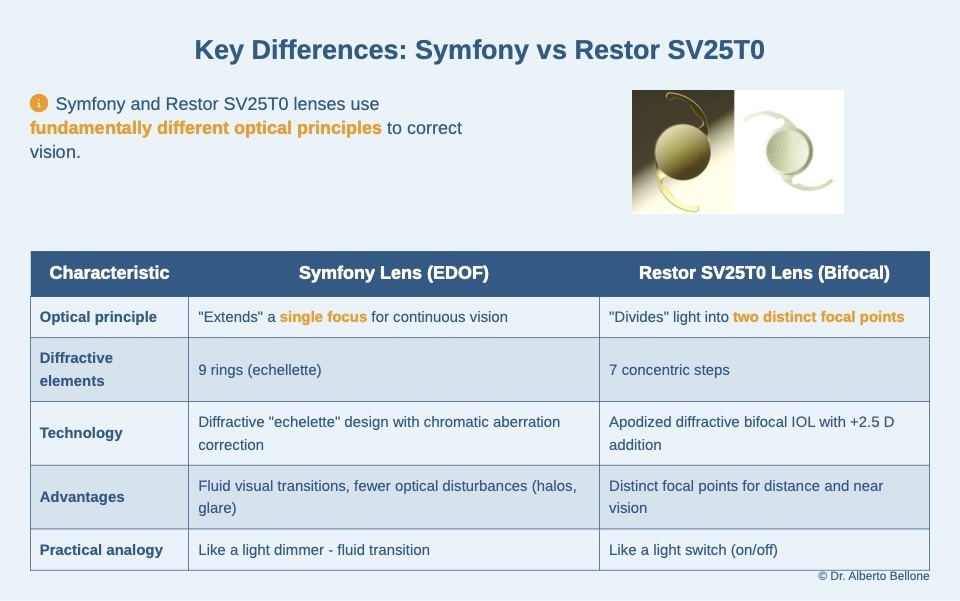
2. TECHNICAL FEATURES COMPARED
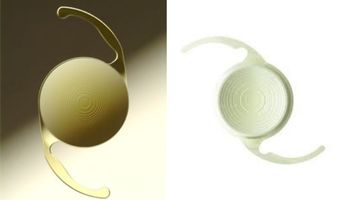
TECNIS Symfony Lens
• Number of diffractive elements: 9 rings (echellette)
• Optical principle: Extended single focal point
• Technology: Echellette diffractive design with chromatic aberration correction
• Advantages: Smooth visual transitions, fewer optical disturbances (halos, glare)
AcrySof ReSTOR SV25T0 Lens
• Number of diffractive elements: 7 concentric steps
• Optical principle: Two distinct focal points (distance and near)
• Technology: Apodized diffractive bifocal IOL with +2.5 D addition
• Features: Classified as a multifocal lens
 3. ARCHITETTURA DIFFRATTIVA DELLA SYMFONY Distribuzione degli Anelli 1 9 anelli diffrattivi sono organizzati in due
zone funzionali: Zona Centrale (diametro 2.75 mm): – Contiene 3 echellette – Sfasamento: 3m – Funzione: Devia il 41% dell’energia luminosa al secondo ordine di diffrazione per il fuoco intermedio Zona Periferica: – Contiene 6 echellette – Sfasamento: 2.73m – Funzione: Invia il 21% dell’energia al fuoco intermedio Caratteristiche Uniche • Altezza maggiore: I gradini sono più alti rispetto alle IOL bifocali tradizionali • Correzione cromatica: Compensa l’aberrazione cromatica longitudinale • Ordini di diffrazione: Utilizza il 1° ordine per la distanza e il 2° per l’intermedio 4. IL MECCANISMO: COME NASCE IL FUOCO ALLUNGATO Il Segreto dell’Aberrazione Cromatica Cos’è l’aberrazione cromatica? È un fenomeno ottico per cui una lente non mette a fuoco tutti i colori nello stesso punto. La luce blu si focalizza più vicino, quella rossa più lontano, creando dispersione cromatica. Come la Symfony la sfrutta: 1. La parte refrattiva della lente ha un’aberrazione cromatica naturale 2. I 9 anelli diffrattivi sono progettati con aberrazione cromatica di segno opposto 3. Il risultato: Invece di eliminarsi, le due aberrazioni si bilanciano creando una serie continua di punti focali La Nascita del Fuoco Esteso La correzione incrociata delle aberrazioni porta tutti i colori dello spettro visibile a fuoco in punti consecutivi e molto vicini. Questo crea una “striscia” continua di visione chiara – la caratteristica distintiva dell’EDOF. 5. SPIEGAZIONE SEMPLIFICATA Analogia Pratica Immaginiamo la differenza tra: – Lente bifocale (Restor): Come un interruttore della luce (acceso/spento) – divide la luce in due punti netti – Lente Symfony: Come un regolatore di luminosità (dimmer) – crea una transizione fluida Come Funzionano i 9 Anelli Pensate agli anelli come a piccole “rampe circolari” che guidano la luce: – 1 3 anelli centrali: Più “potenti”, creano la visione intermedia continua – I 6 anelli esterni: Supportano il lavoro mantenendo la visione chiara senza disturbi Il Vantaggio del Design • Più alti: Gestiscono meglio tutti i colori della luce • Più efficienti: Non sprecano energia luminosa • Più fluidi: Creano un’unica zona di messa a fuoco allungata 6. CONCLUSIONI Dimostrazione Scientifica La lente Symfony non crea semplicemente un “secondo fuoco” come una bifocale. Utilizza un design diffrattivo avanzato per: 1. Manipolare attivamente l’aberrazione cromatica 2. Trasformare un difetto ottico in un vantaggio 3. Creare un fuoco unico, continuo e allungato.
3. DIFFRACTIVE ARCHITECTURE OF THE SYMFONY LENS
Ring Distribution
The 9 diffractive rings are organized into two functional zones:
- Central Zone (diameter 2.75 mm):
- Contains 3 echelettes
- Phase shift: 3 microns
- Function: Redirects 41% of light energy to the second diffraction order for intermediate focus
- Peripheral Zone:
- Contains 6 echelettes
- Phase shift: 2.73 microns
- Function: Sends 21% of the energy to the intermediate focus
Unique Features
- Greater height: The steps are taller than those in traditional bifocal IOLs
- Chromatic correction: Compensates for longitudinal chromatic aberration
- Diffraction orders: Uses the 1st order for distance and the 2nd for intermediate vision
4. THE MECHANISM: HOW THE EXTENDED FOCUS IS CREATED
The Secret of Chromatic Aberration
What is chromatic aberration?
It’s an optical phenomenon where a lens does not focus all colors at the same point.
Blue light focuses closer, red light farther, causing color dispersion.
How Symfony takes advantage of it:
- The refractive part of the lens has a natural chromatic aberration
- The 9 diffractive rings are designed with an opposite-sign chromatic aberration
- The result: Instead of cancelling out, the two aberrations balance each other, creating a continuous series of focal points
The Birth of Extended Focus
This cross-correction of aberrations brings all visible spectrum colors into focus at closely spaced points.
This creates a continuous “strip” of clear vision — the hallmark of EDOF technology.
5. SIMPLIFIED EXPLANATION
Practical Analogy
Imagine the difference between:
- Bifocal lens (ReSTOR): Like a light switch (on/off) — splits light into two distinct points
- Symfony lens: Like a dimmer — creates a smooth transition
How the 9 Rings Work
Think of the rings as small “circular ramps” that guide light:
- 3 central rings: More “powerful”, generate the continuous intermediate vision
- 6 outer rings: Support the function, keeping vision clear and undisturbed
Design Advantage
- Taller: Better handle all light colors
- More efficient: Do not waste light energy
- Smoother: Create a single elongated focus zone
6. CONCLUSIONS
Scientific Demonstration
The Symfony lens does not merely create a “second focus” like a bifocal.
It uses advanced diffractive design to:
- Actively manipulate chromatic aberration
- Turn an optical flaw into an advantage
- Create a single, continuous, elongated focus point.

