


Stargardt disease is an inherited macular dystrophy that leads to progressive loss of central vision, typically manifesting during childhood or adolescence. It is caused by mutations in the ABCA4 gene and follows an autosomal recessive inheritance pattern.
Inheritance and Probability of Manifestation in Heterozygous Twin Siblings
As an autosomal recessive condition, an individual must inherit two mutated copies of the ABCA4 gene (one from each parent) to develop the disease. If both parents are healthy carriers (heterozygous), each child has:
- 25% chance of being affected (homozygous for the mutation).
- 50% chance of being a healthy carrier (heterozygous).
- 25% chance of inheriting no mutation.
The probability of both siblings being affected by Stargardt disease is calculated by multiplying their individual probabilities: 25% (0.25) for each, resulting in a combined probability of 6.25% (0.25 × 0.25 = 0.0625).
Retinal Differences in Monozygotic Twins
Monozygotic twins originate from the division of a single zygote and therefore share identical genetic material. However, despite their genetic identity, fingerprints and retinal characteristics exhibit individual variations. Studies have shown that while the fingerprints of monozygotic twins are similar, they are not identical due to environmental influences during fetal development. Similarly, retinal imaging may reveal differences between monozygotic twins, reflecting the uniqueness of each individual.
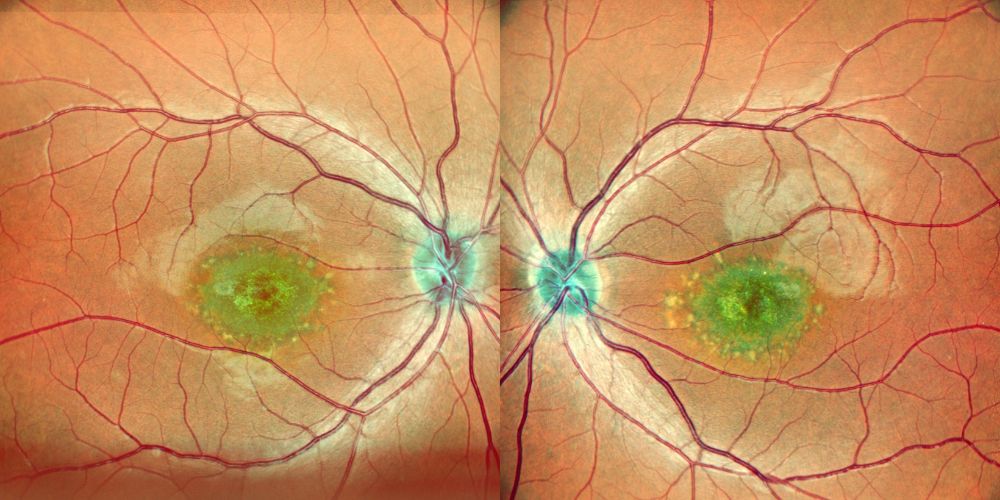
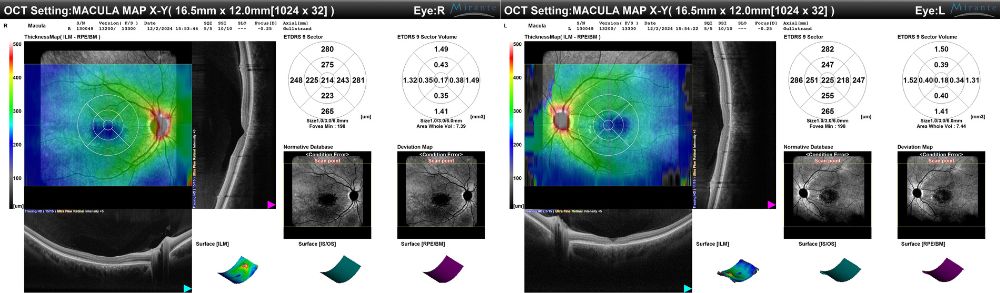
In this specific case: the retinal images of the two siblings are markedly different, and their somatic appearances also highlight numerous differences.
Vascular Alterations in Stargardt Disease
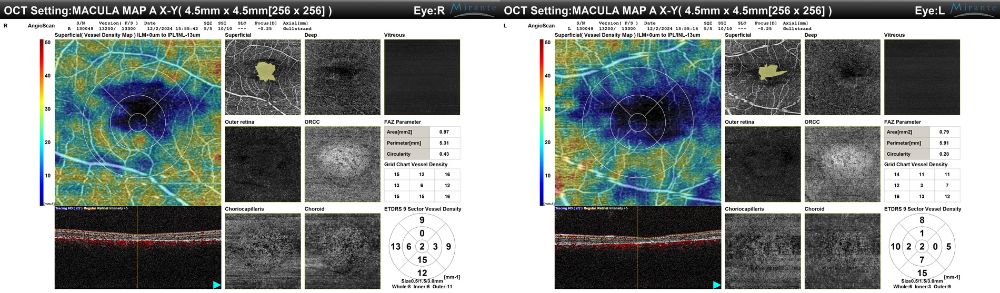
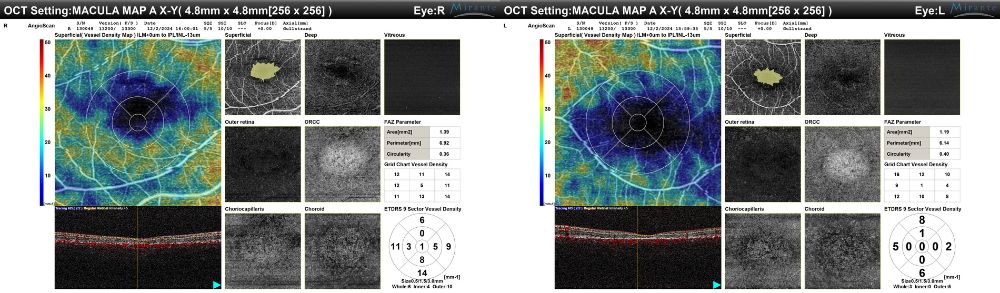
Stargardt disease is associated with vascular changes in the retina and choroid. Studies using OCT angiography have demonstrated an enlargement of the foveal avascular zone (FAZ) and a reduction in macular perfusion at various stages of the disease. These vascular alterations progress as the disease advances, contributing to the central vision loss characteristic of the condition.
Stargardt disease involves a complex interplay between genetic and environmental factors, influencing clinical presentation even among genetically identical individuals. A thorough understanding of these dynamics is essential for accurate diagnosis and the development of effective therapeutic strategies.
(Note: OD refers to the right eye and OS refers to the left eye.)
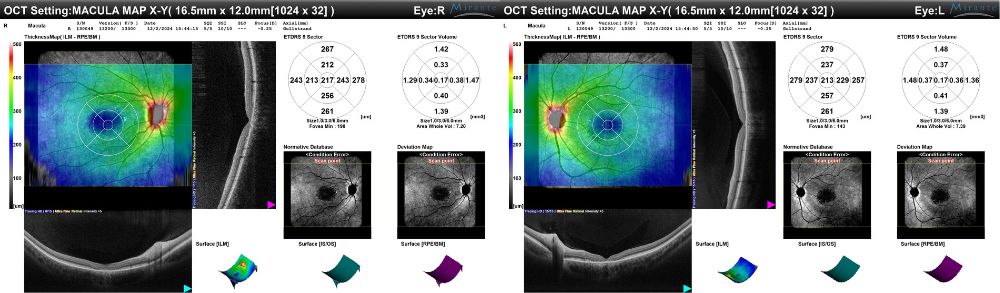
Brother 1 Retinography OD OS

Brother 1 OCT OD OS
Brother 1 OCT Angiography OD OS
Brother 2 Retinography OD OS
Brother 2 OCT OD OS
Brother 2 OCT Angiography OD OS